

rethinking student goal setting

Student goal setting is powerful and has been backed research.

As with anything, there are multiple ways to use current research in a classroom.  After reading EXECUTIVE TOUGHNESS, I lean more towards the idea of challenging students to create process goals instead of results-based goals.

What are wrong with traditional goals?

  1. They can undermine happiness or sense of accomplishment.  A student who sets a goal of a 90% might never feel good enough until they accomplish it.
  2. Product goals create emotional highs and lows. Students either feel good because you “hit” a target, or feel like  a failure for coming up short.
  3. They suggest you can control things that you don’t have control over.  A fifth grader who makes a goal of jumping 2 reading levels really can’t control that.  Can they take steps to make that happen? Sure, but at the end of the day, this goal is really outside of their control.

Instead, let’s set process goals.  Have students create goals based on things they can control, and focus on the process. Teach students that they can be happy with who they are, but still strive to do better.


A proposal for goal setting:

Traditional Process Goals
  1. Think of a goal (Perhaps smart goals)
  2. List 3-5 Steps to help achieve the goal
  3. Post the goal in a prominent place so it ‘motivates you’
  4. Revisit the goal
  1. Identify a goal (maybe using smart goals)
  2. Identify the systems and processes that need to happen to achieve that goal (2-3)
  3. Focus on the process, revisit the systems and use the process as the goal
  4. Occasionally revisit the product/traditional goal.

I’m not slamming traditional goal setting, I’m just thinking, this may be a better way.  If we can get students to commit to a process, then the traditional goal will come along, and they’ll have developed powerful habits along the way.

Educational Leadership Lessons Learned at Summer Camp

I have spent nearly two decades, working, attending or volunteering at summer camps.

When I was getting my master’s, I ended up overseeing the logistics and staffing at a large summer camp, with over 600 campers.
One (of many) reasons I went into educational leadership was the spark that was ignited when I accepted my first leadership position at this summer camp.  Below, I’ve outlined the most powerful lessons learned over those years that have been invaluable in my work as a school administrator.

  1. Provide excellent customer service
    • I truly believe in creating raving fans.  I hate the idea of “under – promising and over-delivering”. It’s best to make your vision clear, and then deliver it, 100% of the time, with excellence.
  2. Create and sustain a vision
    • Every camp can be exactly the same.  I learned from my old camp director, that it’s important to see a place/person/company for what it can be, not what it is.
    • In just 3 short years working for my YMCA camp, I saw it grow.  It expanded from 150 campers, 30 staff members, and a small pool…. into two giant pools complete with waterslides, 3 Jet boats for water skiing, a zip line, rock wall and sports-specific programs. That kind of change doesn’t happen without vision.
  3. It’s ok to be the “bad guy.”
    • Someone has to tell the 19-year-old counselors that their idea is dangerous, or that it doesn’t fit the vision and mission of the camp.  Someone has to be the one to tell parents that their child will be asked to leave for hurting someone (‘Oh, and by the way, you aren’t getting your deposit back’).  Having difficult conversations became a part of my job, and I’m thankful for that.
  4. “Everybody” and “Somebody” are both myths.
    • There are l,000 + jobs that need to get done at camp on any given day, just like a school. “Somebody” has to do them.  There is an old story that sums up my feelings about this:
There was an important job to be done and
Everybody was asked to do it. Everybody was sure Somebody would
do it. Anybody could have done it, but Nobody did it.  Everybody
thought Anybody could do it but Nobody realized that Everybody
wouldn’t do it. It ended up that Everybody blamed Somebody when
Nobody did what Anybody could have done.

Honorable mention: Scheduling & Budget

  • We put together a master schedule with 40 groups, 6 special areas and somehow included swimming, waterfront and rock wall times.  Learning how to do this before I stepped into my first administrative job was not only helpful but crucial.
  • Likewise, we had an operating budget of over $1,000,000. Managing that wisely was key, especially because in public education – you are managing tax-payers hard-earned dollars.

a new kind of kindergarten orientation

What if we could teach and inspire families all while giving them important information and sharing our values?  During this year’s kindergarten orientation, we tried to do just that.

This was my first event as an leader at my new school.  A few leadership lessons that were taught/reinforced:

  1. Start with why – Simon Sinek
  2. First who then what? – Jim Collins <—-BIG TIME, we have a great team!
  3. Scripting the critical moves – Heath Brothers

Our goal – stay student-centered all while providing the information that families need to know.

Instead of the standard ‘sit and get’ that most parents experience at orientation, we tried a station model, and the results were powerful.  Students were happy, families had the chance to get their questions answered, and teachers were able to form powerful relationships.

Our rotations were simple, yet effective. Our ideas may not be original, but they were original to my school.

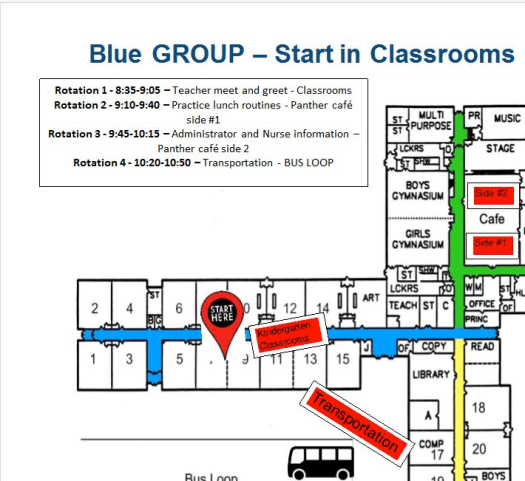
  1. Students came in and were given a map of the school with a group color and center rotations on the top (see below for a sample group map)
  2. We kicked off with some music and an announcement.
  3. After each station, familes rotated to the next station.
  4. There were never more than 16 families at any one station.
  5. At the end, we said thanks for coming, and our wonderful PTA handed out shirts and other goodies for the kindergartners.

The stations were set before I even came aboard, and worked flawlessly.  Flexibility was key, as we needed to adjust the times (each session ended up being too long), and tried to incorporate new ideas as they were suggested.

Our rotations were:

  1. Meet your teacher – (We ended up with no more than 5 families in a class due to the randomization of the groups)
  2. Administration –  code of conduct overview and Q & A with our School Nurse Teacher
  3. Transportation – Bus safety and bus ride, along with decorating the front entrance with sidewalk chalk
  4. Potpurri – Cafeteria exceptions, RAPTOR sign in, and volunteer forms.
    •  Since our cafeteria is next to the main office, we had the kids go though the line, get a snack and then head over as a family.
    • We use a RAPTOR system for visitor management, so we called this ‘express registration.’
    •  Fill out ‘PTA connect’ forms.

There were of course challenges – the rotation was new for many families. Did families show up late and miss some rotations? Sure, but every kid was able to meet their teacher at the end of the day.

We collected feedback and are looking forward to making it even better next year. Here’s a sample schedule for the ‘blue group.’


Screen Shot 2017-09-01 at 5.03.54 PM (2).png