
-
More creativity – It’s true, author Austin Kleon shares that the best artists are the ones who have the best routines
-
Calmness – If you have a predictable system, you know how to break down even the biggest tasks. The growing number of things on your plate isn’t overwhelming, they are just cogs in your system.
-
Time to do what you want – Productivity Systems don’t exist so you can do more work. They exist so that you can find time to do things that are beneficial to you and those around you. They exist so that you are able to devote your full attention and energy to something that matters, giving it the appropriate time, not waiting until the last minute.
Cal Newport describes this in part as the 4 C’s of the deep life.
dual-coding: quick implications for elementary students
Dual coding in an intriguing concept in education. Though “learning styles” have been debunked, they still often make an appearance. We hear people say things like “I’m a visual learner.” The truth is, we all benefit from the use of both auditory and visual systems, and ‘learning styles’ are a myth. (Kirschner & Hendrick, 2020).
This is the idea behind dual coding – that pictures and words together are the best ways to learn. Perhaps this is obvious, but it seems as though in education, we don’t dive deep enough into why and how this can work better. First off, when using both systems, we will find that associations and connections can arise – they are often deeper and longer-lasting. These connections have additive effects on memory and this effect is stronger than if you only use one system. Connections and additive effects are key as we investigate deeper into the transfer of knowledge. (For me specifically, between intervention and classroom performance)
Implications for elementary students:
- Use animation and narration when explaining concepts. This is better than text + pictures. Explain diagrams verbally.
- Don’t make the mistake of re-reading the text either- you might think the redundancy helps, it’s actually a common misconception.
- Place text and pictures near each other when presenting and explaining concepts
- Offer images and texts at the same time
- Use concrete examples coupled with pictures to explain complex thoughts
- Appeal to the imagination– Have students create their own mental images of something that you discussed
- Knowing more leads to doing more. Students require knowledge of objects and content in order to support further development
This has been adapted from the work of Kirschner & Hendrick. Their book is a must-read for educators.
Online Discourse Through Questioning
Relationship sustaining
If you follow “edutwitter”, you know that one can be popular by putting up a quote over a picture about building relationships. Bonus points if you find a picture of a cute kid, or can attribute the quote to a famous person. You actually don’t have to say anything of value, as long as you share that relationship building is important.
But I deeply, and respectfully, feel as though we are missing so much more when we talk about “relationship building.” Building relationships is a tool in creating what we really desire: Connectivity. The truth, that seems to escape us, is that relationship building is easy, it’s the maintaining and sustaining of relationships that are difficult and essential.
If we look at relationships in terms of consistency, we know that doing a grand gesture for someone once a year isn’t going to make them like you forever. It’s powerful, but that’s not going to sustain the relationship you built. It’s the little, boring things that make relationships. Asking how someone is doing and waiting to actually hear the answer; the secret handshake with a student, referencing an interest a student has in a lesson. Those little things build consistency, those are what sustain relationships.
Alternatively, Inconsistency is what harms relationships.
Too often we see “relationship building” as an event, a matter of intensity. Connectivity and caring are about the consistency you bring to a relationship. A kind note means nothing if you don’t treat people well. As I write these words, many schools are doing COVID parades. Those don’t mean much if you haven’t brought kindness to your students during the physical school year.
It’s amazing to know a student’s family and get to know their background and hobbies. But that is SUCH a small part of a relationship. The question is, can we sustain that relationship when the student doesn’t meet expectations. Can we sustain that relationship when we, as a adults don’t meet expectations our students have of us?

Consistency is needed for maintaining those relationships. If we think of it as the gym – going once doesn’t make you fit. Going consistently does. You can mess up and miss a workout, but if you get back to your plan, you will likely be ok in the long run.
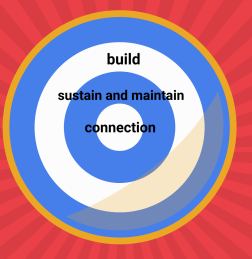
So, while I very much appreciate the sentiment behind relationship building, I believe we should focus on what’s really important: connectivity to school. That’s the “Bulls Eye.” Relationship sustaining is the next ring worth the second-most points. Of course, building relationships is a start.
Works referenced/of Interest:
Video: Why consistency matters in Leadership – Simon Sinek
Henrey Ford Quote: “Coming together is the beginning. Keeping together is progress. Working together is a success.”
Email for the Busy Educator
To-Do lists that actually work
One (often overlooked) way to promote social-emotional health is to create systems that allow us to focus on deep, meaningful work. tasks & to-do lists aren’t bad, but the feelings of overwhelm/anxiety that come with them are. This playlist focuses on 3 different types of lists that may support your work.
3 Minute Tutorials
3 Minutes on recording using PowerPoint: https://www.youtube.com/watch?v=4wU4M5gj8RY
4 Minutes on uploading existing plans to schoology: https://www.youtube.com/watch?v=n6umtqRSH2M
stillness is the key: implications for school leaders – Part 1
A few months ago I read a book called “Lead Yourself First: Inspiring Leadership Through Solitude.” It changed the way I think about silence and solitude, so when “Stillness is the Key” was recommended, I immediately picked it up. Ryan Holiday writes on the idea of stillness- which is deeply personal – but I’ve found a few parts that resonated with me as a school leader.
Seek time for silence. Holiday writes that good leaders don’t just “go with their gut,” – the best leaders have the fortitude and strength to slow down and think. He cites John F. Kenndey in the Cuban Missile Crisis, who was far from passive in this conflict. He took time to think in the Oval Office, Rose Garden, and the White House swimming pool before making decisions. Thomas Carlyle even writes “There is no thought without silence.”
We also need to close the door and think. As Carlyle writes – “how can a leader think when bombarded with constant inputs?” Slowing down and thinking doesn’t mean you are a bad leader & it doesn’t mean you don’t seek action.
Sitting and thinking on complex problems allows a leader to “look deeply, and perceive what others cannot.” Holiday notes that even sitting with doubts are key. When you sit with doubts and think about them, the other side of those thoughts will always bring some sort of truth or clarity. Holiday notes that before a decision can be made, we must think about it, be fully present, clear our mind of preconceptions, weigh advice we have heard, and then decide.
It is difficult to find silence as a school leader. There is always someone who needs help, and that’s a good thing! But finding even small moments of silence is key. This is why Holiday recommends walks – walking around the building allows a leader to soak in the beauty of what happens day-to-day in a school. Even on the most difficult days, there is a lot to celebrate in a school community. Remember, silence doesn’t have to be still – it just has to be absent of other voices having input into your thoughts.
I once had a professor in ‘principal school’ say that the best decisions don’t always turn out the way you may have liked – the best decisions come from a solid decision-making process. We can find clarity in our thinking and decision making the process through stillness – then, we must act on it!
Summer 2019 RtI
Upfront Summary.
Before dismissing the RtI framework, or the MTSS/PBIS models associated with it, educators, specifically school leaders should address the following:
- It is not necessary to wait in Tier – 1 when students identify as needing additional support
- Choose either growth or achievement for determining when exiting students from Tier 2 & 3 interventions, and be consistent across the board. (A combination of the two may be most reliable).
- A true understanding and of success can only be achieved through consistency. Not only of the actual intervention but also for: teacher training, intake and exit protocols, team meeting protocols and finally the assignment of interventions to match the different tiers.
There is no shortage of information about Response to Intervention and its effectiveness in schools. Below, I outline some of the more recent research surrounding it, with a specific focus on elementary schools.
To begin, it’s apparent that schools across the country are frustrated with RtI and its effectiveness, and understandably so – a significant body of research has shown that perhaps it is not effective after all. (Bath, 2017) However, there is substantial research to suggest that there are commonalities in the hold-ups to RtI.
To wait or not
NOT – Otaiba et al (2014) used a controlled experiment of first-grade literacy students to understand the dynamics of waiting on Tier 2 or Tier 3 intervention, versus intervening immediately. The research suggested that “there was no reason to delay intervention.” This is in stark contrast to the idea that students should wait 6-8 weeks in Tier-1 instruction and see how they respond, before providing intervention.
Growth or Achievement to Measure Responsiveness
A debate rages on whether student progress should be measured in growth or against a standardized achievement scale. Milbur, Lonigan & Philips, 2017, report that perhaps the best indicator would be a combination of the two. This would result in perhaps the most conservative criteria for a student to “exit” RtI, but is likely the most accurate. Before a school can identify whether a student has made progress, this would be a key insight to agree on. If not, there is a significant disparity in exiting students from Tier II and Tier III interventions. (Milbur, Lonigan & Philips, 2017).
Consistency – A Must
As stated above, consistency, like most things in life is key. Unfortunately, the research overall suggests that schools and school districts are not consistent with their approaches, cut-offs, and interventions. Several types of research show that there is a need for consistency in training among the instructors providing Tier-2 intervention – be it classroom, or specific intervention teachers. Additionally is the need for consistency in the intervention itself. Finally, a requirement of proper protocols for assigning interventions, be it the length of time or intensity, is critical to determining whether it RtI is effective or not. Without these factors “the impact of being assigned to receive intervention service….was not significantly significant. ”
Works Cited/Consulted:
https://journals.sagepub.com/doi/abs/10.1177/0731948717745646?journalCode=ldqa
https://nyuscholars.nyu.edu/en/publications/response-to-intervention-is-the-sky-falling
Year Two Thoughts
It’s almost July, and the perfect time to reflect on the 2018-2019 School year. Last year, I shared my thoughts about the first year in school leadership. Year two is over, and I have some additional thoughts. Perhaps they are not groundbreaking, but these two ‘agreements’ have been invaluable to me this year. Experience really is the best teacher, so bring on year three!
Leadership is a constant balance of dichotomies. Jocko Willink writes about this in his book, and boy is it true. As a leader, you are constantly in a battle of knowing how hard to push, when to say something, when to remain quiet and so on. One thought I found really powerful, and think about frequently is the dichotomy in relationships. We talk about relationships in education more than anything else it seems. But of course, relationships can be unprofessional if not plain inappropriate. You can be too close and too involved where staff feel like they can say things that may not be professional, or don’t see you as their leader. Of course, you can be too removed where you don’t even know a single thing about those you work with – tough family situations, challenges you can help with, or even their personal and professional goals. You can be so distant that those you work with won’t even share their struggles with you or give you honest feedback. Building and keeping appropriate relationships is one of the major dichotomies that I think is VERY tricky when it comes to leadership.
Leadership can be lonely – that’s actually a really good thing sometimes. I find that in the interest of shared decision making, I’m given a lot of information and data from numerous perspectives. We live in a world of podcasts, youtube, books, constant communication, and other “inputs.” These are important for personal and professional development, but the ability to sit and think on a problem, with no other minds involved, is critical. You have to able to shut the door, physical or otherwise, and think. Even with tons of input, shared philosophies, strongly upheld opinions- a decision will come down to you. Make sure you take time to think about your decision by yourself. This could be a single minute or an hour. I’ve enjoyed journaling for this reason – it allows specific time for reflection and deep thought. I’m still learning and growing in this area – but I loved the book Lead Yourself First as a way to begin the process of solitude and how it relates to leadership.
What’s next? Well, through deep thought and solitude, I realize more and more that next year, I have to work on delegation and building capacity. I’m big on servant leadership, but with the discussion of dichotomies above, I often find myself just doing things for people, rather than leading them to learn for themselves. That’s the dichotomy I’ll be working on next year, so please send any resources my way!